Imagine a small fire starts in your kitchen. You grab the nearest fire extinguisher. But what if it's the wrong one?Surprisingly, using the wrong extinguisher can make a fire much more dangerous.
A fire involving paper is very different from one involving cooking oil, electricity, or flammable chemicals.
That's why there are several types of fire extinguishers, each designed for different situations.
Let's understand them in simple language.
🔥 First, Not All Fires Are the Same
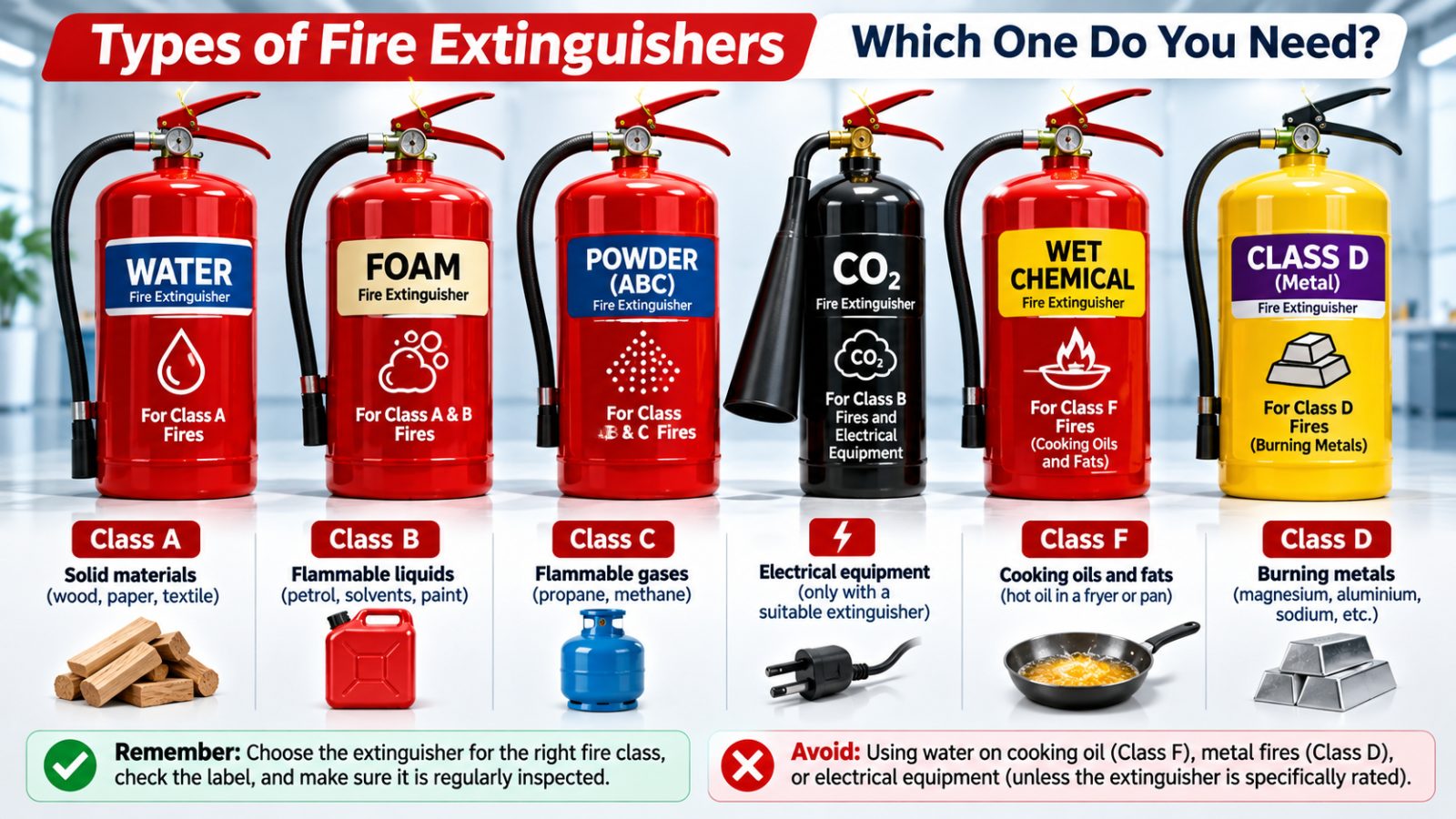
In Europe, fires are divided into five main classes based on what is burning.
Fire classWhat is burning?Example
ASolid materialsWood, paper, fabric
BFlammable liquidsPetrol, paint, solvents
CFlammable gasesPropane, methane
DBurning metalsMagnesium, sodium
FCooking oils and fatsHot oil in a deep fryer
Here's something important: There is no separate electrical fire class in the current European classification system.
Electrical equipment requires an extinguisher specifically marked as suitable for the relevant voltage and safety distance.
Also, American fire-class letters are different, so always follow the classifications and instructions used in your country.
🧯 1. Water Fire Extinguisher — The Cooling Specialist
Best for: Class A fires
Imagine a wastepaper basket catches fire.
A suitable water extinguisher can cool the burning paper and help stop the flames.
Water extinguishers are commonly used for materials such as wood, paper, and textiles.
But be careful!
Never pour ordinary water onto burning cooking oil. The water can instantly turn into steam, throwing burning oil into the air.
Ordinary water extinguishers are also not suitable for many flammable-liquid and metal fires.
For electrical equipment, only use extinguishers specifically approved for the conditions.
🫧 2. Foam Fire Extinguisher — The Protective Blanket
Best for: Classes A and B, when rated
Imagine a small spill of flammable liquid catches fire.
A suitable foam extinguisher can help by forming a layer over the burning liquid.
This layer separates the fuel from the surrounding air and helps prevent flammable vapors from escaping.
Foam extinguishers are commonly found in workplaces where flammable liquids are present.
However, not all foams work with every solvent. Some liquids need special alcohol-resistant foam.
Remember: Foam is not automatically suitable for live electrical equipment, metal fires, or burning cooking oil.
🌫️ 3. ABC Powder Extinguisher — The All-Rounder
Best for: Classes A, B, and C
ABC powder extinguishers are among the most versatile types.
They contain a special dry chemical powder that interrupts the reactions sustaining a fire.
They're useful for several common fire hazards, including burning solid materials and flammable liquids.
But there's a disadvantage.
The powder can spread everywhere, reduce visibility, and damage sensitive electronic equipment.
It also doesn't provide the same cooling effect as water.
Important: ABC powder is not suitable for every fire. Metal fires and cooking-oil fires need different extinguishing agents.
For a gas fire, the gas supply must be shut off safely. Extinguishing flames while gas continues leaking can allow an explosive gas mixture to form.
💨 4. CO₂ Fire Extinguisher — The Clean Option
Best for: Class B fires and certain electrical equipment fires
Picture a small fire involving electrical equipment in an office.
A CO₂ extinguisher may be an appropriate choice if the fire is still small and the extinguisher is suitable for the conditions.
CO₂ works by displacing oxygen around the fire.
Its biggest advantage?
It leaves no powder or foam residue.
That's why CO₂ extinguishers are often found near electrical installations, laboratories, and server equipment.
However, there are serious limitations.
CO₂ does not cool burning materials very effectively, so some fires can reignite.
Even more importantly, using CO₂ in a small or poorly ventilated room can create a life-threatening atmosphere.
Never assume that CO₂ is safe simply because it doesn't leave a mess.
🍳 5. Wet Chemical Extinguisher — The Kitchen Specialist
Best for: Class F fires
Imagine you're cooking dinner and the oil in your frying pan catches fire.
Your first instinct might be to pour water onto it.
Never do that.
Water can cause burning oil to splash violently, producing a dangerous fireball.
Wet chemical extinguishers are specially designed for cooking-oil and fat fires.
They form a protective layer over the hot oil and help cool it, reducing the chance of reignition.
They're especially important in commercial kitchens and restaurants.
If a small pan fire occurs, switching off the heat and covering the pan with a suitable lid may be possible without putting yourself at risk. Never carry a burning pan.
⚙️ 6. Class D Extinguisher — For Burning Metals
Best for: Class D fires
Some metals can burn intensely, particularly when they're in the form of fine dust, powder, or small pieces.
Examples include magnesium, sodium, and certain metal powders used in industry.
These fires require special extinguishing powders designed for the specific metal.
Ordinary water or the wrong extinguisher can cause a violent reaction.
This type of fire is especially relevant in industrial manufacturing, metal processing, and some laboratories.
One common misunderstanding: A lithium-ion battery fire is not automatically a Class D metal fire.
Lithium-ion battery fires require a different emergency response, with special attention to cooling, toxic gases, and possible reignition.
Untrained people should not attempt to tackle a smoking or burning large battery.
📋 Quick Guide: Which Extinguisher for Which Fire?
SituationTypical suitable extinguisherBurning paper or woodWater, foam, or ABC powderFlammable liquid fireAppropriate foam, powder, or CO₂Flammable gasIsolate gas supply; trained responseBurning metalSpecial Class D extinguisherCooking oil fireClass F wet chemicalElectrical equipment fireProperly rated extinguisher, often CO₂Lithium-ion battery fireSpecialized response and cooling
Always check the actual extinguisher label. This table is a general guide, not a replacement for training or a fire risk assessment.
🚨 What Should You Do If a Fire Starts?
Knowing the different types of extinguishers is useful. But knowing when not to use one is even more important.
Your first priority should always be protecting people.
Raise the alarm. Warn others and call emergency services. In the EU, the emergency number is 112.
Keep your escape route clear. Never allow a fire to block your way out.
Only consider fighting a very small fire. It must be safe to approach, with little smoke, the correct extinguisher, and appropriate training.
Follow the extinguisher instructions. For many models, remove the safety pin, aim at the base of the flames, squeeze the handle, and sweep the discharge across the burning area.
Leave immediately if conditions worsen. Never risk your life to protect equipment or property.
If you are unsure, evacuate and let professional firefighters handle the situation.
🏭 Why This Matters in Workplace Safety
In Environmental, Health and Safety (EHS), choosing fire extinguishers is more than simply placing red cylinders on walls.
The right equipment depends on the hazards present.
For example, an office, a chemical laboratory, and a metal manufacturing facility may require completely different firefighting arrangements.
A proper fire risk assessment should consider the materials used, potential fire scenarios, electrical hazards, the location of extinguishers, and employee training.
Extinguishers also need regular inspection and maintenance.
💡 The One Thing to Remember
The most important lesson is surprisingly simple:
There is no single fire extinguisher that is suitable for every fire.
Water cools. Foam forms a protective layer. Powder interrupts combustion. CO₂ displaces oxygen. Wet chemicals help control cooking-oil fires.
Each has a purpose—and important limitations.
Understanding those differences can help you make safer decisions at home and at work.
Because in an emergency, the right knowledge can be just as important as the right equipment.